The Infrastructure of Intelligence
I have always been fascinated by how power shifts between empires: the Silk Road connecting civilizations, energy transitions reshaping what societies could build, and ambitious missions that turned breakthroughs into foundational technologies. Such missions compress decades into years. The Manhattan Project took fission from theory to reality in three years, and Apollo landed on the Moon eight years after the goal was set. The next mission of that scale is building the physical layer of intelligence, where energy, compute, and materials converge. Every leap in civilization has been an energy transition, and as Jevons Paradox predicts, each gain in efficiency raises demand. Lighting became 3,000 times cheaper while consumption rose 25,000-fold. AI is accelerating this cycle at unprecedented speed: inference costs are falling roughly 10× each year, tokens consumed per task are rising 10×, and data center electricity demand is projected to more than double to 945 TWh by 2030, more than Japan consumes today. Scaling intelligence therefore requires three transitions in parallel: a grid that can deliver new power, compute that uses it more efficiently, and new materials that make both possible.

Energy: Power Electronics to connect a Global Supergrid
I spent my career working on how electrons are stored and moved, from Tesla's battery packs to Lightyear's solar car to grid storage at Universe Energy. The next frontier is the grid itself.
Power generation is not the bottleneck; interconnection is. By the end of 2025, more than 2,060 GW of generation and storage sat in US interconnection queues, with a median of over five years from request to operation. Large transformers took about 2.5 years to deliver, with a projected 30% supply deficit.
The answer is a software-defined grid built on power electronics. Their performance is set by how strong an electric field a semiconductor can withstand before it breaks down. A stronger field lets a thinner device block the same voltage with far lower losses, and that advantage grows with the cube of the field. Silicon breaks down near 0.3 MV/cm, silicon carbide at about 3, gallium oxide around 8, and diamond around 10.
The remaining barriers are materials engineering: doping, defect-free substrates, and packaging that survives fast switching at high voltage. Solving them over the next five years, alongside high-voltage direct current (HVDC) transmission and small modular fission reactors supplying firm power near major loads, can lay the foundation for a terawatt-scale supergrid, where every node becomes a power router and energy flows like data.

Compute: Building chips like the brain
My first talk, at age nine, was about laser beams. Decades later, light could help solve one of computing’s biggest problems: moving data. Power electronics can deliver gigawatts to data centers, but that power is wasted if the chips inside spend more energy moving data than processing it. The bottleneck is no longer just how fast we compute, but how efficiently we move information. Since transistor scaling stopped delivering effortless gains in the mid-2000s, computation has become cheaper while memory access has improved far more slowly. Adding two 32-bit numbers takes roughly 0.9 picojoules; fetching one from main memory can require 640 picojoules, about 700 times more.
The brain takes a different approach: memory sits close to computation, neurons communicate selectively, and the entire system operates on roughly 20 watts. The next generation of computing will follow the same principles: bring memory closer to compute, minimize data movement, and use light to move information.
That means rebuilding the chip stack from the ground up:
1) Light. A single waveguide carries dozens of data streams on different wavelengths with little heat, and photonic chips can perform computation directly on light.
2) Diamond. With roughly five times the thermal conductivity of copper, diamond can draw heat away from beneath the hottest transistors.
3) 3D stacking. With heat under control, memory can sit directly on top of processors, shrinking data paths from centimeters to microns.
4) Specialized chips. Milliwatt-class processors bring intelligence to the edge: into power grids, satellites, and autonomous labs.
The opportunity is to build a new computing architecture in which materials, photonics, memory, packaging, cooling, and manufacturing are designed as one system. This demands a Manhattan Project for the chip stack: not another incremental improvement, but a coordinated reinvention of how computation is built. The goal is to make computation more parallel, local, efficient, and adaptive, like the brain.
Materials: Programming Matter, Starting with Heat
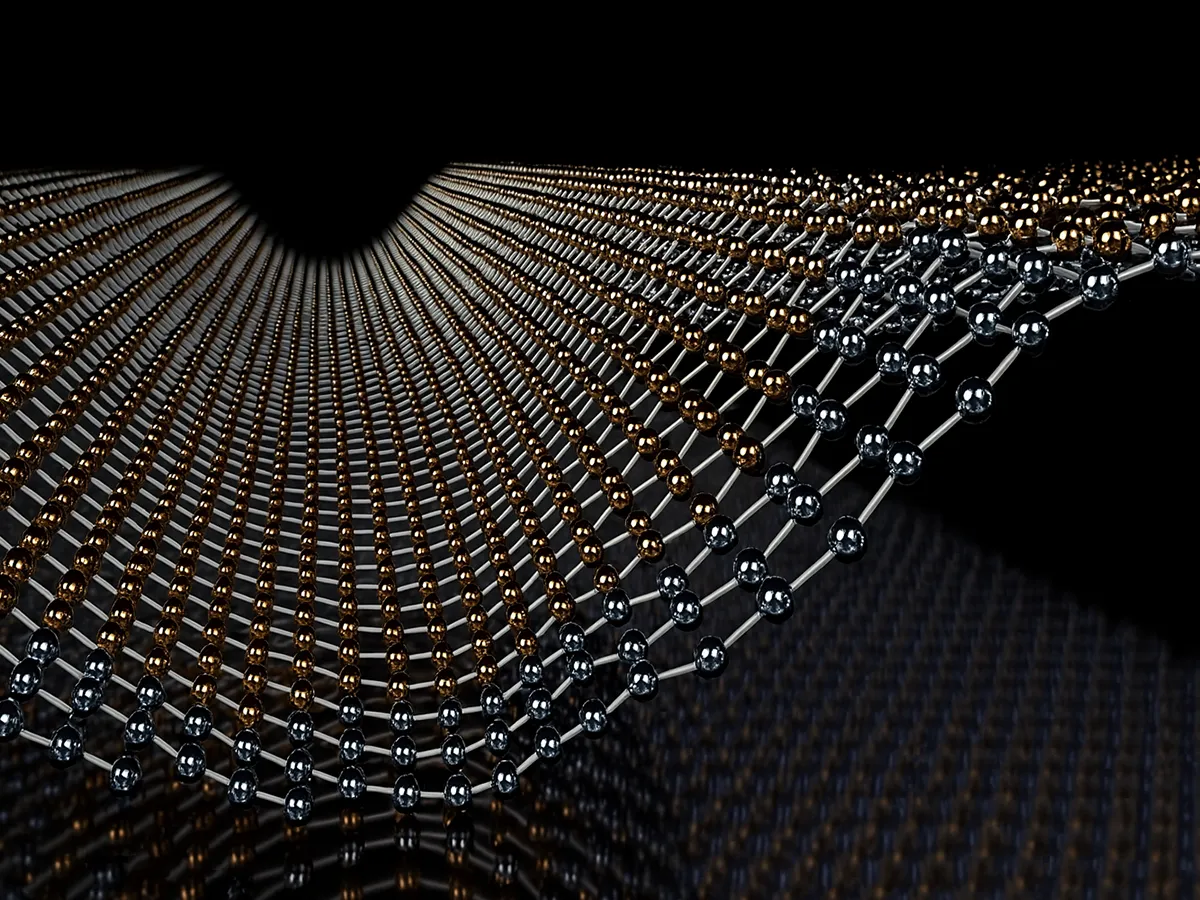
Every layer of that stack, from diamond substrates to photonic waveguides, starts with a material that has to be discovered, made and perfected, and that process still takes decades. Then very watt becomes heat, and how fast a material carries it away is decided by its atoms. I first met that limit while building computational fluid dynamics models in aerospace. AI chips have now hit it: one accelerator draws about 1,000 watts on roughly 2 cm² of silicon, and the next generation approaches 2,000. Better plumbing won’t fix this. Better materials will.
At Universe Energy, I saw that the energy transition is gated by materials: we reused EV batteries because new cells could not scale fast enough. A new material has historically taken one to two decades to reach a product. Prediction is no longer the bottleneck, since models trained on quantum simulation now propose millions of stable candidates. The bottleneck is making and testing them, because most predicted materials have no known synthesis route, and failed experiments are rarely recorded.
A closed loop solves this. AI designs, robotic labs synthesize and measure around the clock, and every result, including every failure, trains the next design. Reinforcement learning chooses the experiment that teaches the model the most, and the reward is a measured property, not a predicted one.
Chip cooling is the first target and a gateway. The capabilities developed here, including growing diamond, controlling defects and engineering materials atom by atom, also advance photonics for compute and power electronics for the supergrid. The same discovery engine can then tackle superconductors, which carry current without resistance and could cut the supergrid’s transmission losses close to zero.
These transitions reinforce one another. Better materials enable more efficient power electronics and denser compute; abundant power and efficient compute accelerate the discovery of better materials. Each turn of the loop makes the next one cheaper, until Earth itself becomes the limit.
The Next Frontier is Space
Jevons showed in 1865 that more efficient steam engines burned more coal, not less. Intelligence will follow the same pattern. As it becomes cheaper per watt, we will not use less energy. We will find more to compute, build, and explore. Eventually the constraint shifts from efficiency to scale, as Earth's land, grids, and materials become the ceiling. The answer is not a smaller ambition but a bigger frontier. In orbit, sunlight delivers about 1,361 W/m² without night, clouds, or weather, and Earth intercepts only a sliver of the Sun's output. Everything built for the grid on Earth becomes the foundation for infrastructure in orbit: power electronics for laser power transmission, photonics for low-energy data, and thermal materials that turn radiators into cooling for orbital compute. Space is not just the next place for infrastructure. It is humanity's next great frontier to explore, build, and discover.
CONNECT
Want to learn more? Get in touch.
I'm open to collaborating with founders, researchers, and engineers in building frontier technologies that expand human potential.